Birthday Celebration

July 17th, 2010

Birthday celebration has been an important and joyful event in modern human living.  For parents, the birthday of a child brings much happiness to know their child has experienced another year of emotional, mental and physical growth. However, in holding parties and giving presents to the birthday person, many usually don’t give much serious thought on “What are we celebrating?”, nor for the birthday person to think “What entitles me to expect and receive presents in simply getting one year older?”

In old time China, children celebrate birthdays for their parents and elders to express their gratitude for the love and support they have received from them.  Rarely did parents celebrate birthdays for their babies and children as in the West.   However, nowadays, all are westernized.

There is nothing wrong to find opportunity or an excuse to have a joyful gathering, to enjoy a good time together.  On the other hand, the deeper meaning of birthday celebration may have been lost.  In China, it used to be thought that ideally birthdays should be a day for reflection.  This is a day for people to reflect and appreciate the love and support they have received in the past year from family, friends, society, Heaven and Earth.  This is a day for people to reflect on their inner growth and outer progress in the year just past and to see if it matched or exceeded what they have received from outside in return. This is a day to meditate on making adjustment and setting a new goal for the coming year.

For the birthday person to show their appreciation for the love and support they have received, this is an occasion to give instead of to receive.  In many cultures, such as the traditional American Indian culture, instead of the birthday person receiving gifts, they would give gifts to those who come for the celebration.

I always tend to shy away from celebrating birthdays in the “normal” way.  This year,  in taking advantage of the rare occasion that I  am able to stay home for more than a month without  traveling abroad,  I decided to  celebrate my birthday with  a “21-day Lemon Juice Fast” to cleanse  my body.  Feng Shui is about designing a good living environment. Our Body is the living environment for our spirit and soul. Regular detoxification practice is a good way to ensure good feng shui for our spirit and soul.

I have now entered the 6th day of fasting and feel much better already. I will give a final report at the end of this fast.

Shan-tung Hsu Feng Shui

Feng Shui and Religion

April 19th, 2010

Does religion have a role in Feng Shui?

This is a frequently asked question.
The answer is: No.  Feng shui is not a religion nor has it ever followed any religious tradition or practice.

However, most religious groups do apply feng shui principles in building their temples and monasteries. Most Taoist and Buddhist temples in China are built on a site that nourishes spiritual energy.

China Temple

Headmaster Monk, Dr. Hsu and group at Temple Site

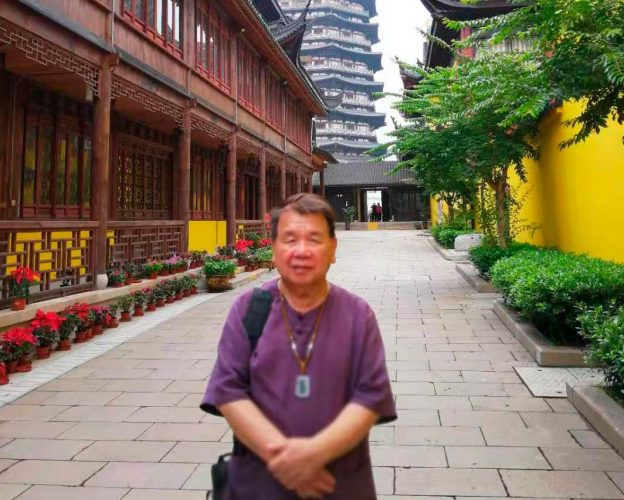
Last November, I was invited by the headmaster of Yunjui Shan (雲居山Cloud Residing Mountain) ,in Jinagxi, China,  to locate a proper site to build a new meditation and training center for the monastery. This Ch’an (zen) monastery, was established during the Tang dynasty and has over 1200 years of history.  The headmaster was very much into feng shui and I found him also sensitive to the energy of the land.  Since my suggestion was very much in accord with what he had in mind, he was very happy with my visit.

This past March, he once again asked me to help with the proper positioning of the gate for a new temple. High up in the mountain, in the rain and cold, the master walked so briskly through the woods and muddy ground, that I had to pay attention to keep up.   Overall, it was a most interesting and rewarding experience.

Dr. Hsu with Headmaster monk

Dr. Hsu with Headmaster monk

From all the Buddhist and Taoist temples I have visited, I hardly find a temple without good feng shui.  Although in general, the energy at such sites is more supportive of spiritual cultivation and may not necessarily support business or commerce.

Good feng shui for business requires a more mundane energy, which in general means sites are on low ground, such as cities close to bodies of water.  Temples, on the other hand, are for spiritual cultivation, thus are mostly located on mountains or higher ground in a city.

Balance with the intended purpose is one of the key considerations of feng shui design.

Shan-tung Hsu Energy, Feng Shui

Google in China

April 3rd, 2010

Google logoOn April 12, 2006 Google’s CEO, Eric Schmidt, formally announced Google’s business name in China;   谷歌 (Guge)。During recent months there has been a soap opera played out between the Chinese government and Google, over which Google made the decision to move its operation to Hong Kong.   Then on April 3, 2010,   Google decided to discontinue using its Chinese company name and replaced it with “Google in China”.  The Chinese name, Guge, was used for just under 4 years.

A name as well as logo represents the information level of a company, for everything in the universe has matter, qi-energy, and information attributes.  Therefore, all successful companies have a good logo and name. When Google’s Chinese name was chosen and announced four years ago, I was very surprised and commented it was not a good sign for Google’s operation in China.  Google could have easily chosen a better name.  I wondered who was behind this naming? Doesn’t Google have better talent in its Chinese team to foresee the future difficulty by using this name?  I was puzzled.

The Chinese word Gu means Valley, Ge means Song or Singing. To sing and to have the energy extended, to have the song heard in a big way, one should stand on high ground, on top of a mountain or on top of the Great Wall, not in a valley. A valley means one is confined and trapped.

Things always begin on the information level, moves to the qi-energy level and than on to physical manifestation.  What happened today for Google was already determined when it chose its Chinese name four years ago. It was destined to fail.  Maybe by restoring its name to English it will have a 2nd chance in China.

Shan-tung Hsu Energy

On “Living Environment”

March 18th, 2010

body & mindThe purpose of Feng Shui is to create a good living environment for all living beings. The “environment” in Feng Shui concepts exists in all scales; the planet, continent, region, city, neighborhood, house, room, and down to a favorite chair.

It is important to realize that our body and mind co-exist. On a more fundamental scale, our body is the “living environment” of our mind, and our mind is the “living environment” of our body. By taking care of our physical health, we provide a good living environment for our mind.  Therefore, a sound and tranquil mind, provides a good environment for our body.  This is the very first Feng Shui concept we need to concentrate on. Good Feng Shui design for harmonious living begins with our bodies and minds.

Shan-tung Hsu Feng Shui

Half of China

March 7th, 2010

teaThe last two months, I have had the rare luxury of not adding more frequent flyer miles to my account by staying in Seattle to diligently work on two books;  Feng Shui:  Truths, Myths and Misconceptions and The Essence of Chinese Tea.

To give you a little taste of what’s to come, the story below is taken from my book The Essence of Chinese Tea. Hope you enjoy it!

Half of China

In 1972, President Nixon made his first visit to China, re-establishing diplomatic recognition between the United States and China.  Chairman Mao presented President Nixon with 200 grams of Wuyi Dahongpao tea as a gift.  Nixon was puzzled, and privately remarked that Chairman Mao’s gift seemed rather small for such a historical event.  When Premier Zhou En-Lai heard this, he privately explained to Nixon that this kind of tea came from very special tea trees that were hundreds of years old.   All six trees together produced only some 400 grams of tea per year.  “So you see” said Zhou En-Lai “Chairman Mao has already given you half of China.”

Shan-tung Hsu Tea

2010 – The Year of the Tiger: A Year of Power and Courage. Watch the Monkey Show!

February 20th, 2010

TigerThe patience and endurance of the ox have led us through this very difficult year.  Recession has led to high unemployment.  The health care reform process has gone nowhere.  Money is still being printed and borrowed to sustain the war.  Internationally, there was a devastating earthquake in Haiti, a worldwide economic recession, and a stalemate over climate issues.  Everyone has been facing challenges.

In entering the Year of the Tiger, we are looking for improvements.  Everyone, though, is anxious about what the year will actually bring us.  In Yin-Yang theory, when Yin reaches a maximum, it turns into Yang; when things reach their worst, they begin to improve.  The question is, of course, whether Yin has yet reached its maximum.

In the United States, the New Year freeze on the east coast does not seem like a good omen.  On the other hand, it may indicate that the rate of decline has slowed down.  There may be a bit farther to go, but it won’t be as sudden.

At least we are entering the Tiger year.  The tiger is a symbol of power and courage.  So we should at least have more energy and power to deal with the difficulties we have.

This is the first Tiger Year of the new century. This is a very young tiger — just a cub.  It might be daring and courageous, but it has not yet developed its strength.  It is said that when the tiger is absent, the monkey will take control.  Indeed, we see lots of monkeys have taken their place on the stage.  We have too many monkeys running around our houses — both “D” monkeys and “R” monkeys.  Monkeys can be manipulated or trained, but their nature cannot be changed.

Politically, it seems that the usual self-correcting mechanisms no longer work.  We need some fundamental change.  We need to take control of our houses away from the monkeys.

Internationally, we cannot expect to have much to celebrate.  Friction, disharmony, and stalemates will continue between countries.  We can only hope that there will be no extraordinary surprises.

On the individual level, we may not have the power to affect the international, or even the domestic situation.  But we do have the power to change ourselves — our reality, and our perceptions.  We are invested with the vigor and valor of the tiger, and we can bring that energy to our lives in this year.

Many people have found that they have survived the difficulties of the last year better than they expected.  People have adapted:  finding different ways to deal with situations, different ways to live their lives.

People have found they can still be happy with less, in ways that lead to subtle spiritual unfolding.  The ability to hang on in these difficult times leads to a transformation in values, and in outlook on life.

Fundamental change in government requires fundamental change in society.  Fundamental change in society requires fundamental changes on the part of individuals.

As for Blue Mountain, we are happy to report that many teachers have stepped forward in Europe and Russia to take responsibility for teaching Feng Shui workshops, spreading the core teaching of Blue Mountain Feng Shui—“In harmony with nature, in tune with the heart”.  With the help of Taras Latvin, of Kiev in Ukraine, by the end of spring the Russian-language Blue Mountain Feng Shui web site should be finished and posted.  Shan-Tung Hsu and Jenny Hones have been working on a new book, Feng Shui: Truth, Myths and Misconceptions.  We are keeping our fingers crossed — but it should be published before the beginning of summer.

Shan-Tung Hsu has also taken a side trip to work on another favorite subject, and is writing a book on The Essence of Chinese Tea.  We expect to have a big tea party this summer in Seattle to celebrate the publication of this book.

People born in the years of the Horse and Dog should take advantage of this year:  it is the best year for them to make progress.  This is a year of change for those born in Tiger years.  For Monkeys, move cautiously!  The rest are fairly neutral, though people born in the Pig year might do well in relationships.  People born in the Rooster year should be careful about investments.

We have to take life seriously, but remember that when you see monkeys playing around and we are powerless to do anything about it, take it lightly; feel free to laugh.

For everyone:  stay firm, breathe steadily, and keep focused.  Don’t look back.

Shan-tung Hsu Chinese zodiac, Feng Shui

Ask Mother Earth for Answers

November 23rd, 2009

Human beings live between Heaven and Earth, nourished by Yang and Yin energy.  The energy of Heaven comes downward from above, manifesting as sunshine, rain and so on.  The energy of Earth rises upward from below, manifesting as food, water and other nourishing products.  Heaven (yang) energy implies dynamic expansion while Earth (yin) energy implies collection, connection, cooperation and nourishment.  Without the effects of Earth’s energy that emerges to balance the outward expansion of Heaven’s force, there will be conflict and strife.  What are the most powerful factors in manifesting Earth energy, the energy of connection and cooperation?  The answer is trees, forests and all vegetation.  The places that tend to have more conflict in the world are just those places that lack forests, or that have undergone recent, sudden deforestation. In modern history, there are positive correlations between the depletion of natural forests and the general level of strife and chaos in the world.  This is the source of the problem.
In the arenas of politics, economics or other specialized spheres, there is constant effort to control chaos and conflict.  The emphasis is not on how to solve the issues but on how to not create further problems.  Due to this, there will always be an uphill battle to find a fundamental solution to today’s issues.  From a feng shui perspective, the best solution is found in Mother Nature.  We must look at it from an energy (chi) level.   Chaos and conflict means there is too much Yang energy so it is necessary to increase the nourishing Earth or Yin energy or increasing energy for cooperation and support.  How do we go about this? We must begin by planting trees and establishing greenery all over the world.  In the meantime, where forests are abundant, water will be abundant. And water, to the planet, is like blood in the human body.  Photoxpress_4780633
The global warming and the increase of CO2 is the modern urgent concern.  While people search for different ways to find solutions, which are often complicated, we should just ask our Mother Earth for a solution.   According to a scientific study, 20% of CO2 is attributable to deforestation, which is more than all of the world’s cars and trucks combined.  Let us stop and take the time to think.   How much of a positive impact will there be in solving the CO2 issue if instead of deforestation, we increased forestation?

Shan-tung Hsu Feng Shui, Yin-yang

The Beauty of Imperfection

November 3rd, 2009

A good old friend, an architect, came to visit from out of town.  He brought along a few house models to discuss the design from a feng shui perspective.  My friend is a Black Feet American Indian, who is tall, handsome and a gentlemen.  In contrast to his commanding physical presence he creates intricate and beautiful beadwork.

There is a special bead-ring he designed showing five different color figures:  white, black, yellow, red and brown.  Each color represents the different colors of people in the world.  The design of these five people, hand in hand, symbolizes world peace.  He had shown a similar bead-ring to me a long time ago and I always remembered it because it impressed me so.  During lunch, he showed me another bead-ring that he recently made.  While I was admiring it, putting it on my finger, he said, “I do not want to give it to you because there is some flaw”.  I smiled, put the ring back on my finger and said “it is mine now”.

People are always looking for perfection, appreciate perfection and have difficulty accepting imperfection.  If a beautiful blue and white, Ming dynasty vase has a small chip or has a fine hairline crack, the commercial value will drop dramatically. This is true for many objects.   Why is it, that a vase with a small chip, no longer looks beautiful to us anymore? Why can’t we enjoy something with flaws, even though we are aware the world is full of imperfections?

Navaho and Hopi Indian tribes, purposely leave some flaws and mistakes in their work when weaving carpets or straw baskets.   It is their belief that only God can make perfect things.  This is an attitude of humbleness, the wisdom of learning to accept and enjoy imperfection.

We tend to focus too much on small flaws, and lose sight of the whole picture.  This habit can be seen in our daily lives through our actions toward others, material things and events in our life.  For example, we may think, “this is a beautiful piece of pottery, too bad it has a chip at the bottom” or “he is a nice boy, unfortunately he does not have much patience” or “the party was just perfect, except the soup wasn’t hot enough”.  We always pay more attention to small mistakes, and lose sight of the whole picture.  Such thoughts add to the stress and unhappiness of our lives.

It is inevitable that in life, we will always encounter some flaws, mistakes and imperfections.  If we can learn to accept small flaws, learn to appreciate the beauty of imperfection, we will be a person with more tolerance and compassion and at the same time be more loving.  In turn, it will make us more relaxed and happy. So give yourself and others a break from time to time, as only God can make things perfect!

Shan-tung Hsu Spiritual

Divine Acceptance: Thoughts on the Afghanistan War

October 15th, 2009

In feng shui classes, students often ask: “What happens if I know my place has a feng shui problem, but I cannot change anything structurally (as often it is a rental), nor can I move out any time soon?” My answer often is: “When you cannot do “anything”, there is always “one thing” you still can do: that is acceptance.”

This answer sounds as if we are avoiding the question.  Yet it does have significant meaning to our life.  We find it hard to accept things that are negative, imperfect, defeats us and so on. Life is full of imperfections and the inevitability of those imperfections is hard to accept.  Accepting the reality of the moment does not mean sticking to that moment.  To accept the reality of the present situation does not mean being limited by it; it means knowing the place from where one must start, and once that is known, the next thing to do is to begin the new journey.  And then you know, in due time, things will change.

The United States has been fighting the war in Afghanistan for 8 years and although with 68,000 troops stationed there, we are slowing losing control.  Gen Stanley McChrystal requested a troop surge of a minimum of 40,000; stating, otherwise, the U.S. will be defeated.  Even with that surge, he also knows the U.S. will not win the war in years to come.  As President Obama continues to ponder the strategy, he is clearly aware of what is at stake.  Regardless of hunting Al-Qaida, protecting Afghans are the reason we cannot withdraw.  The fundamental reason to stop us to consider a withdrawal is: we cannot accept defeat, yet we could admit we made a mistake even as early as 2001 when the US invaded Afghanistan.

The rampant Hamid Karzai government’s corruption, the wide spread fraud in the August 20th president election, should be seen as the kindness of   “Heaven” to inform the U.S. to learn the lesson of acceptance.  Afghan has a long history, much longer than the United States.  Beneath the poverty and misery, its people are imbedded with wisdom, pride, strength and tenacity from their deep culture.  They do not need our protection.  It takes wisdom and courage of our new and young president to learn the lesson of the Divine Acceptance; the teaching from the ancient Chinese saint Lao-Tzu, and the lesson from our all accepting Mother Earth.

Accept the train to enter the station, otherwise it cannot move on to the next station.

Shan-tung Hsu Feng Shui

60-YEAR CELEBRATION

October 2nd, 2009

CB013129On October 1st, China held an elaborate ceremony to mark the 60th anniversary of the People’s Republic of China. The impressive parade was followed by a jubilating evening party with an attendance of sixty thousand people.  Indeed, it was a big national party.   In the West, a centennial is a significant bench mark of any celebration, whilst in China, 60 years has significant meaning.

The ancient Chinese use Ten Heavenly Stems (Jia, Yi, Bing, Ding, Wu, Ji, Geng, Xin,Ren, Gui) and twelve Earthly Branches (Zi, Chou, Yin, Mao, Chen, Si, Wu, Wei, Shen, You, Xu, Hai) combining  the two together to form a cycle of sixty.  Heavenly Stems and Earthly Branches were used as the x and y axial to chart the celestial bodies’ movement.  60 years is a significant repetitive circle of sun-moon-earth positions and relationships.  It is not just any abstract number. Since 104 BC, a Han emperor began to use the 60-year cycle to record history.  Infact, it has only been since the last century that the Chinese have adopted the western calendar.   Today, this 60-year calendar is still widely used In Chinese astrology and medicine.

Shan-tung Hsu Feng Shui